Live location
Find vehicles faster, estimate arrival times more accurately and answer customer questions without calling the driver first.
GPS for trucks is no longer just a dot on a map. A good truck tracking system shows where vehicles are, how routes are running and when a vehicle moves unexpectedly. This guide explains when truck GPS tracking is useful, which GPS trackers for trucks make sense in daily operations and what companies should check before choosing installation, data connection and fleet management.
Live fleet tracking
Location, trip history, zone alerts and reports in one dashboard.
Find vehicles faster, estimate arrival times more accurately and answer customer questions without calling the driver first.
Understand completed tours, identify unnecessary detours and make long idle periods visible in daily operations.
Receive alerts for movement, towing attempts or vehicles leaving a defined zone, especially at depots and night parking areas.
Why truck tracking?
Truck GPS monitoring is useful for far more than theft protection. In everyday fleet work, dispatchers need practical answers: Where is the driver now? Why has the truck been standing for so long? Which route was actually driven? GPS in trucks makes these points visible without constant calls between dispatch and drivers.
For logistics companies, service fleets and delivery businesses, the value comes from live locations, trip history, geofencing, speed alerts and better planning for the next job. Depending on the setup, driving behavior, idle time and fuel-related topics can also be reviewed. The important point is transparency: tracking should support organization, vehicle protection and process quality, not hidden surveillance of individual employees.
Legal and operational requirements should be considered from the beginning. Digital tachographs, driving and rest time rules and documentation duties are separate from GPS tracking, but they show why structured vehicle data is already part of many fleets. A clear security concept can also be viewed positively by some insurers when theft risks are reduced and vehicle locations can be documented quickly.
Tracker comparison
The best GPS tracker for trucks depends on the use case. A single tracker for theft protection needs different features than a system for many vehicles with dispatching, reports and driver assignment. For heavy vehicles, stable power supply, robust installation, mobile coverage and a clear dashboard matter more than the smallest possible device.
OBD trackers are quick to set up, while hardwired units are often more reliable for daily truck operations. Magnetic or battery trackers are better suited to trailers, swap bodies or temporary deployments. The real question is not only the purchase price, but whether the tracker receives permanent power, sends alerts reliably and can be mounted without getting in the way.
| Model | Price | Power | Best for | Features |
|---|---|---|---|---|
| Hardwired tracker | from EUR 47.90 | 12/24V vehicle power | trucks, vans, fleets | permanent power, discreet installation, live tracking |
| OBD GPS tracker | from EUR 47.90 | OBD port | light commercial vehicles | quick setup, no workshop appointment, flexible use |
| CAN bus solution | project based | hardwired | professional fleets | additional vehicle data, reports, telematics analysis |
| Mobile tracker | depends on runtime | battery | trailers, swap bodies | no wiring, useful for temporary deployments |
| Magnetic tracker | depends on equipment | battery | special cases | hidden mounting, legal and technical check recommended |
Quick to plug in and useful when the vehicle has an accessible port. For some truck fleets it is too visible.
The better option for permanent GPS tracking for trucks because power supply and placement can be controlled.
Useful for trailers or temporary jobs, but with limited runtime and more maintenance effort.
System and data
Truck tracking systems consist of several parts. The tracker records location and events, sends the data through a SIM connection to a server and makes it visible in an app or dashboard. This turns simple GPS tracking for trucks into a tool for dispatch, security and reporting.
Depending on the device, companies can monitor location, speed, ignition, movement alerts, direction, door contacts, temperature data or external sensors. Many fleets start with live map, trip history and notifications. If deeper vehicle data, driver profiles and reports are needed, the next topic is a telematics system.
Fleet management
Tracking one vehicle is simple. Truck tracking becomes much more valuable when several vehicles are planned together: live locations, driver assignment, zones, trip records and reports reduce questions and make operations more predictable.
A truck GPS tracker with app access is often enough. Simple operation, alerts and a clear trip history matter most.
A dashboard with live map, staff roles and reports for routes, idle time and operating hours becomes useful.
Larger fleets need repeatable processes: telematics data, maintenance views, driver assignment and regular reporting.
Installation
Installation matters in trucks. Many devices are connected directly to the 12/24V vehicle power supply and mounted discreetly. This is more reliable than an exposed plug and helps ensure the tracker remains ready even during long standing times. OBD solutions can be a quick alternative when the vehicle is suitable.
Companies should decide in advance whether they want self-installation or professional fitting. Power supply, antenna position, mobile signal and required alerts should be clarified before rollout. The guide to GPS trackers with SIM explains the data connection in detail.

Inside the vehicle
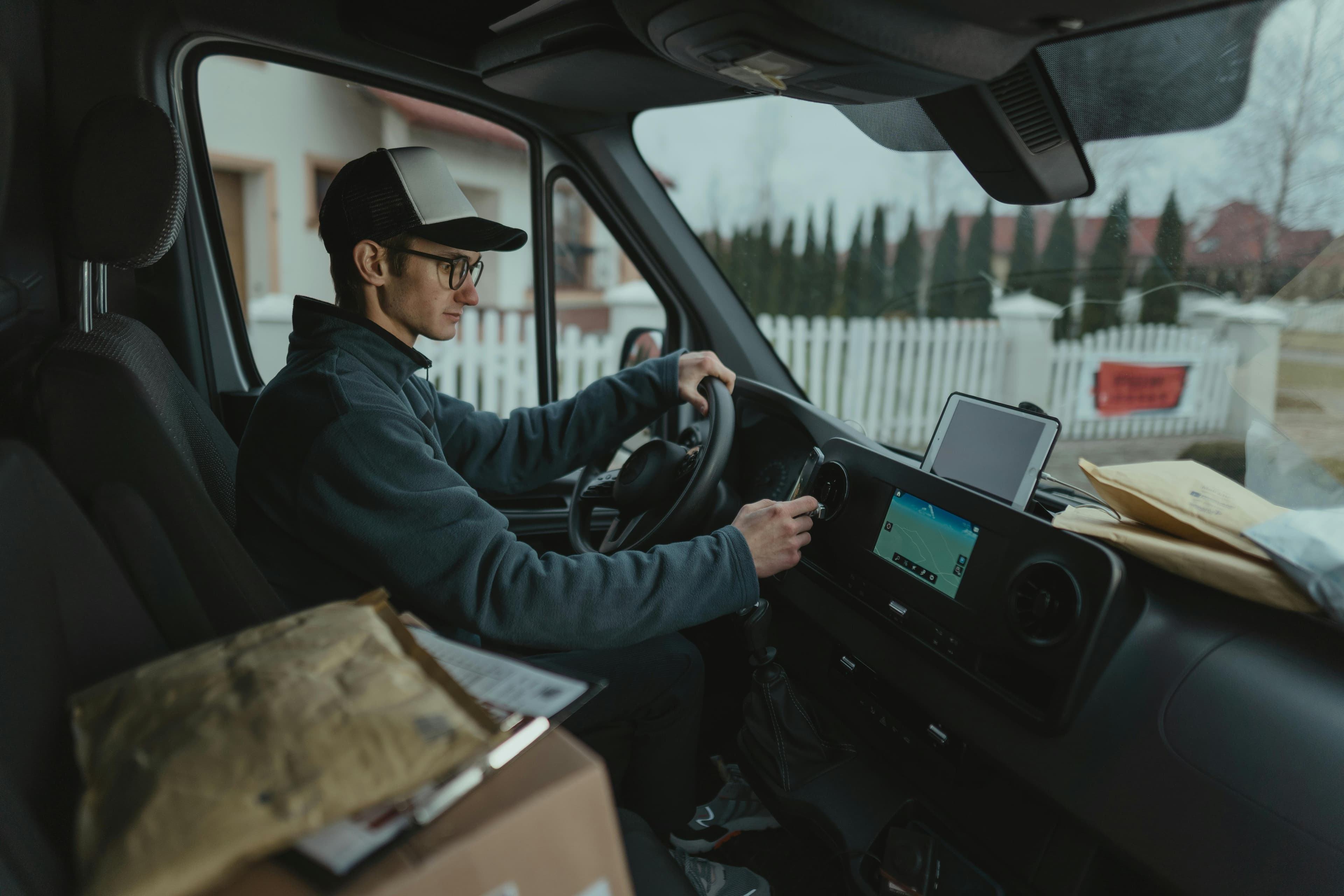
The tracker itself works behind the scenes. For drivers and dispatchers, the important part is that location, routes and alerts are available reliably without disrupting the work inside the cab.
Related solutions
From cars and company vehicles to SIM cards, costs and technical operation, these pages explore each GPS tracking topic in more detail.
Device types, installation and functions for private and commercial cars.
Devices, running costs and SIM options without a fixed provider subscription.
Small portable trackers for vehicles and other objects.
Tracking and managing vehicles used for business.
SIM selection, data volume, prepaid and IoT tariffs.
Determine a vehicle location and detect hidden trackers.
Satellites, SIM, server and app explained clearly.
FAQ
Tell us your vehicle count, operating area and required features. We can help you choose between hardwired installation, OBD, SIM package and fleet solution.